

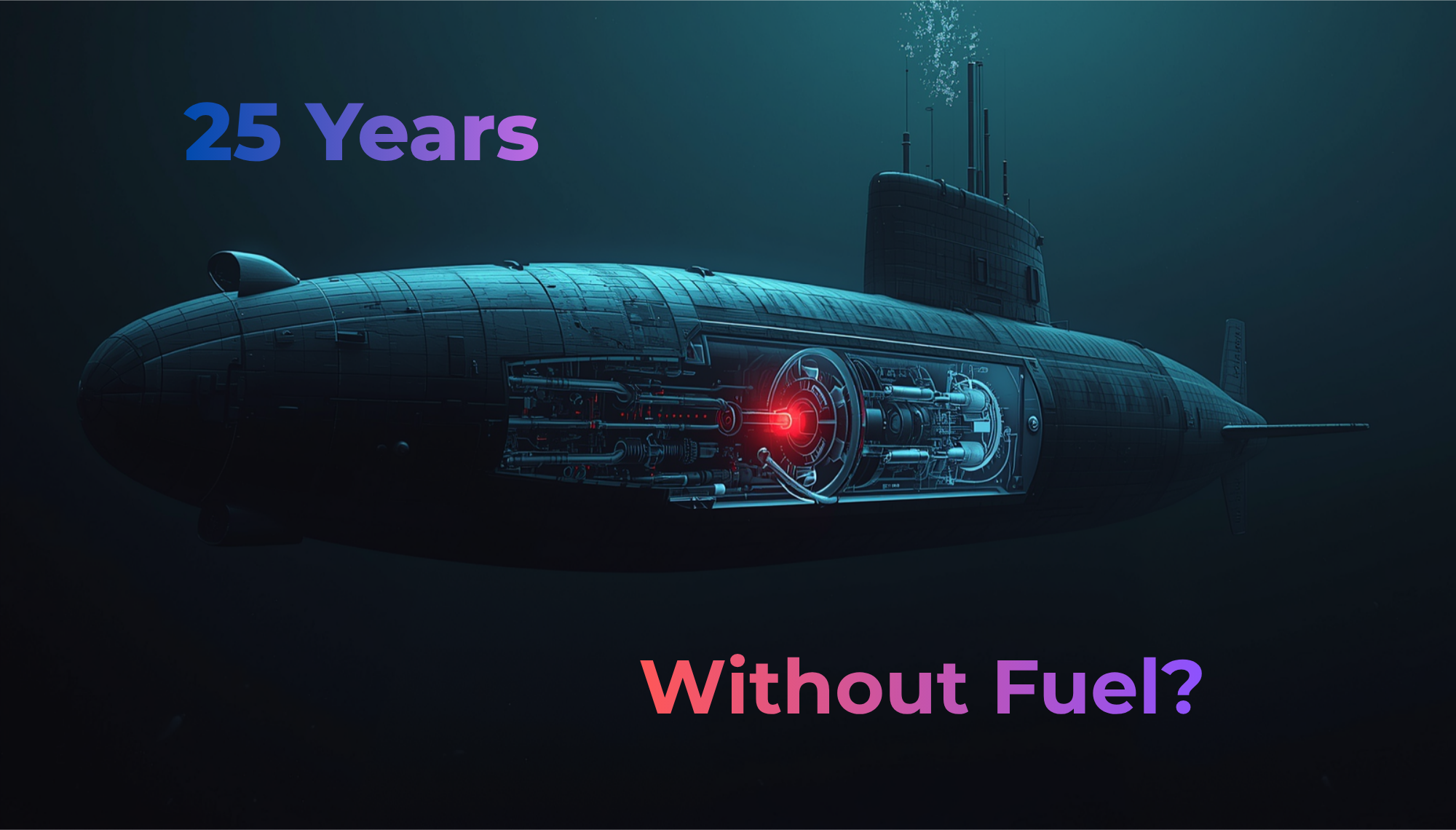
Beneath the rolling swells of the open ocean lies a world of absolute, crushing darkness. Here, at depths where the sheer weight of the Atlantic would flatten a conventional structure, the nuclear submarine operates in a silence so profound it becomes physical. It is not merely a ship; it is a self-sustaining planetoid—a closed-loop ecosystem of steel and silicon designed to keep a hundred souls alive in an environment as lethal as the vacuum of space.
While we often think of naval vessels in terms of firepower, the true marvel of the modern submarine is its independence. In a realm where light never reaches, traditional logistical tethers vanish. This raises the fundamental question of the deep: In a machine that breathes for itself and generates its own power, what is the ultimate limit of human endurance?
The Quarter-Century Core: Engineering a Permanent Heart
The beating heart of this mechanical leviathan is a marvel of physics that effectively deletes the concept of a fuel gauge. While a conventional ship is a slave to its fuel tankers, a nuclear submarine carries its entire lifetime of energy within a lead-shielded chamber.
The propulsion cycle is a masterpiece of energy conversion, operating through a rigorous four-step process:
- Heat (Fission): Inside the reactor chamber, Control Rods manage the “burn” of enriched uranium fuel. As the reactor core splits uranium atoms, it releases a staggering amount of thermal energy.
- Steam (Conversion): A Coolant Loop carries this intense heat to a steam generator, where it transforms water into high-pressure steam.
- Spin (Turbines): This steam screams through the Main Turbine, driving the massive blades that provide both electrical power and mechanical thrust.
- Move (Propulsion): Because a turbine spins too fast for a propeller to be efficient, a series of heavy-duty Reduction Gears steps that speed down, transferring torque to the propeller shaft and out to the pump-jet.
The engineering required to stabilize this process for decades is almost incomprehensible.
The Reactor Profile
- Core Lifespan: ~25 Years
- Operating Temperature: The core throbs at a constant 320^\circ\text{C}
This 25-year fuel cycle is a strategic game-changer. It eliminates the “visible” supply chain of oilers and tankers, allowing the vessel to vanish into the deep and loiter in contested waters for years if necessary. The machine is essentially a perpetual motion device; it only returns to the surface when the humans inside can no longer take the isolation.
Breathing the Ocean: The Chemistry of Survival
There is a grim irony to life in the deep: you are surrounded by billions of tons of water you cannot drink and air you cannot breathe. Survival for months on end requires the crew to live inside a high-stakes chemistry experiment.
Using electrolysis, the ship’s life-support systems literally “crack” seawater to extract oxygen. Meanwhile, the air the crew exhales is continuously cycled through chemical scrubbers where the CO_2 is scrubbed to prevent the atmosphere from becoming toxic. Every breath is a calculated result of mechanical intervention.
This creates a psychological pressure cooker. While the Berthing and Mess areas are “optimized for crew comfort,” the reality is a high-density existence where “privacy” is a foreign concept and the outside world is filtered through sensors and steel. The crew lives in a state of constant chemical reliance, knowing that if the scrubbers fail, the ocean becomes their tomb.
The Grocery Bottleneck: Why Food is the Only Limit
In the most counter-intuitive twist of modern naval engineering, the billion-dollar apex predator of the ocean is ultimately defeated by the humble calorie. The reactor can power the ship for a generation, and the atmosphere can be scrubbed indefinitely, but the human element remains tethered to the pantry.
The primary limitation of a nuclear submarine is its food stores, which typically max out at approximately 90 days. While the “Nerve Center” is packed with 2026-era digital warfare tech, the mission’s duration is dictated by how many crates of frozen peas and canned peaches can be crammed into the Forward Compartment.
There is a jarring contrast between the sophistication of a reactor that splits atoms and the basic human necessity of three meals a day. When the 90-day mark approaches, the 25-year battery becomes irrelevant. The machine is ready for another decade; the sailors are simply hungry.
Seeing with Sound: The AI-Assisted Eyes and Ears
To navigate a world of total darkness, the submarine must “see” with sound. Tucked into the Bow is the Sonar Sphere, a massive acoustic organ that interrogates the dark. Using a combination of Active and Passive Sonar, the vessel can detect the acoustic signature of a distant ship or the jagged edge of an underwater mountain from miles away.
As we approach 2026, the nature of this “vision” is undergoing a digital revolution:
- Next-Gen Acoustic Processing: New sensors can now isolate the faint hum of a distant pump from the background noise of the ocean.
- AI-Assisted Navigation: In the Control Room, artificial intelligence is now being integrated to map complex underwater terrain in real-time.
- Increased Automation: AI is reducing the cognitive load on sonar technicians, filtering out biological noise (like whale songs) to highlight tactical threats.
However, this high-density automation introduces a new paradox: as we hand the “Nerve Center” over to algorithms, the human fallback becomes more critical. If the AI misinterprets an acoustic shadow at 400 meters deep, the crew has only seconds to intervene.
Speed Beneath the Waves: The Silent Sprint
Despite its massive displacement, a nuclear submarine is a remarkably agile predator. When the steam from the generator hits the main turbine and passes through the reduction gears, it generates enough thrust to move the hull at speeds of 25+ knots (46+ km/h).
The true feat of engineering, however, is doing this silently. In the “Silent Sprint,” the propeller or pump-jet must move the ship at high velocity without creating cavitation—tiny bubbles that pop and reveal the ship’s location to enemy sonar. It is a delicate balance of raw power and extreme stealth, a massive structure moving through the water with the grace of a ghost.
Conclusion: The Final Frontier is Closer Than We Think
The nuclear submarine is the ultimate expression of human ingenuity—a marriage of high-energy physics and sheer psychological grit. It proves that we can colonize the most inhospitable corners of our planet, provided we have the right chemistry and enough automation.
Yet, as we look toward a future of AI-managed cockpits and next-gen acoustic processing, the bottleneck remains the same: the person in the berthing rack. We have built a machine that can outlast its creators by twenty years. As we continue to refine these “Masters of the Deep,” the question is no longer how deep the machine can go, but how long the human spirit can endure the silence of the abyss.
Telegram channel For detailed PDF and infographics:- https://t.me/NaveenProductions