
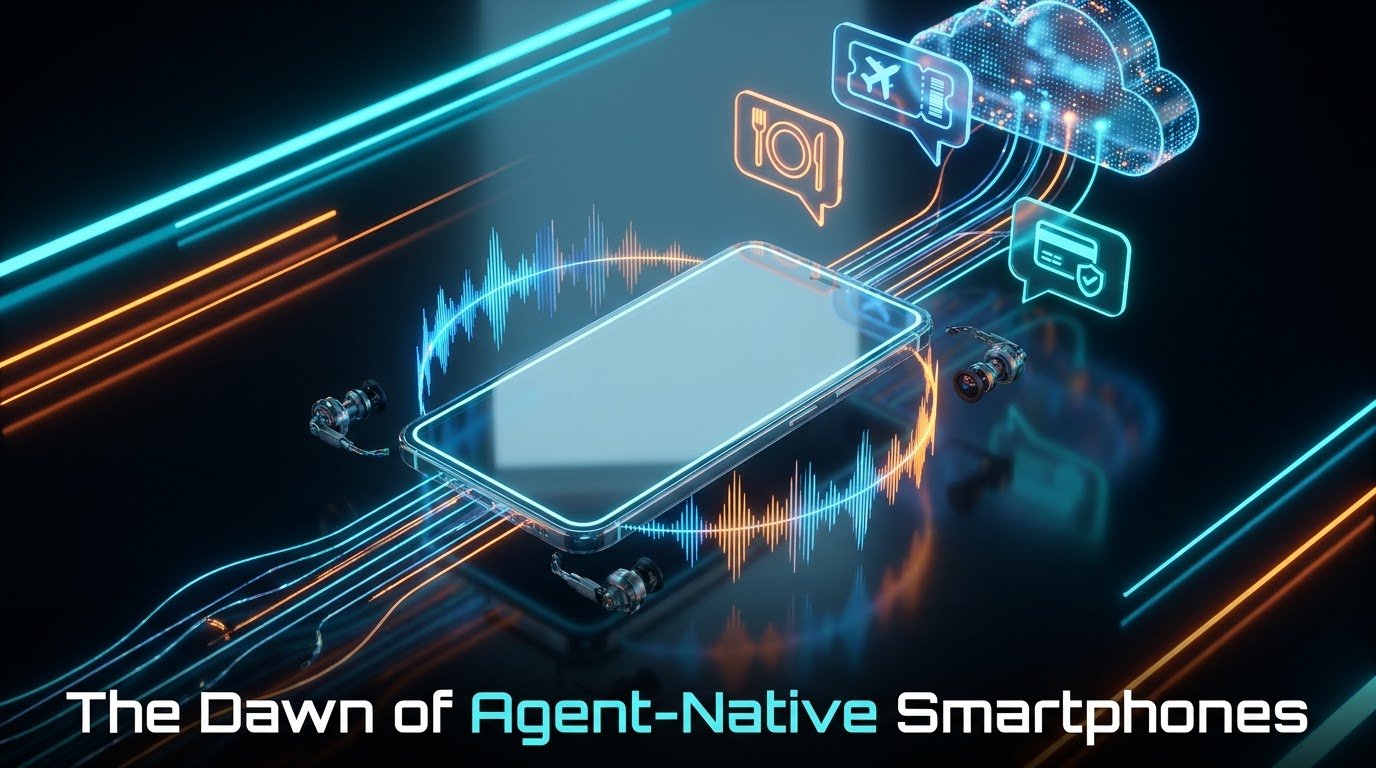
Think about your last thirty minutes on your phone. You likely bounced between a calendar, a messaging app, and a food delivery platform just to coordinate one simple dinner. This constant “app-switching” is a digital tax on our time, a friction we’ve been trained to accept as the cost of connectivity.
At the World Artificial Intelligence Conference (WAIC) in Shanghai, that friction met its expiration date. A new breed of “AI agent-native” hardware debuted, signaling a pivot away from the screen-based UI we’ve used for decades. We are witnessing the moment we surrender the thumb to the voice.
We are Moving from “Assistant” to “Agent”
For years, Siri and Google Assistant acted as mere “routers”—they could open an app, but they left the actual “doing” to you. Agentic phones like the StepFun STEPX Neo and the Nubia NaviX Ultra represent a fundamental shift from software as a tool to software as a doer.
These devices execute complex, multi-app workflows through simple voice commands. StepFun has already secured deep partnerships with giants like Alipay and DiDi, allowing the STEPX Neo to book rides and handle purchases without the user ever touching a button.
Even the Western-developed Natural AI Phone (built by Brain Technologies and SoftBank) is pushing this “agentic” frontier, though its performance remains patchy. While it successfully sent an automated apology message over the LINE app in recent demos, it still struggles with consistency—proving that the “agent” is still learning its craft.
China is Shipping while Silicon Valley is Designing
While OpenAI and Apple remain locked in planning phases or trade secret legal disputes, Chinese firms are already shipping. ByteDance’s “Doubao Phone” prototype sold out its limited run almost immediately, proving the market is hungry for a post-app experience.
The raw power beneath the glass is staggering. StepFun’s STEPX Neo is powered by a trillion-parameter model—a level of local computing that turns a smartphone into a sovereign brain. To grasp the scale of that intelligence, consider this:
“If you sat down to count to one trillion at a rate of one number per second, it would take you 31,700 years to finish.”
The “Great App Blockade” is the New Tech Cold War
This transition has triggered a survival response from the old guard. Within days of the Doubao phone’s release, “Super-App” giants like Alibaba, Tencent, and JD.com restricted the agent’s access. By cutting off unauthorized entry, they effectively broke the agent’s ability to handle financial transactions.
This isn’t just a technical glitch; it is a war for the customer interface. If an AI agent handles the transaction, the platform loses its grip on the user and the data. The “Great App Blockade” is a desperate attempt to prevent the “Super-App” from becoming a “dumb pipe.”
“Platforms want to keep direct contact with their users, otherwise they lose control to another party,” notes Kiranjeet Kaur, associate research director at IDC.
Smartphones are Developing “Personalities” and Limbs
We are finally moving past the “black glass slab” era. Hardware is becoming expressive, reinventing how a device occupies our physical space. Honor’s “Robot Phone” seeks to reinvent the “eye” of the device, while OpenAI is rumored to be reinventing “presence” itself.
- Honor Robot Phone: Features a camera on a moving robotic arm that interprets gestures, bops to musical rhythms, and automatically repositions for stabilized video.
- OpenAI Screen-Free Device: A rumored human-like companion that learns from your emails and uses mechanical elements to create a more “living,” screenless experience.
The Impending Death of the App Economy
In this new world, the “App Store” becomes a vestige of a primitive era. Marc Einstein, Research Director at Counterpoint Research, predicts that within 5 to 10 years, apps will be invisible or non-existent in their current form.
This isn’t just a change in UI; it’s a total disruption of the digital economy. If the company that controls the agent also controls the transaction, the traditional business models of every app developer on earth are suddenly under threat.
“This will fundamentally change the digital economy and disrupt business models,” Einstein predicts.
Conclusion: The Question of Control
The next 12 months represent a hard deadline for Silicon Valley. If OpenAI and its peers don’t move from prototypes to pockets, the center of gravity for the next decade of mobile hardware will shift permanently to Asia.
The technology is ready to act on your behalf, but the trade-off is absolute. Are you ready to trade your agency for an agent? Surrendering the “tap” offers unparalleled convenience, but it forces us to ask: once we stop touching the screen, who is really in control of the device in our pocket?