

Executive Summary
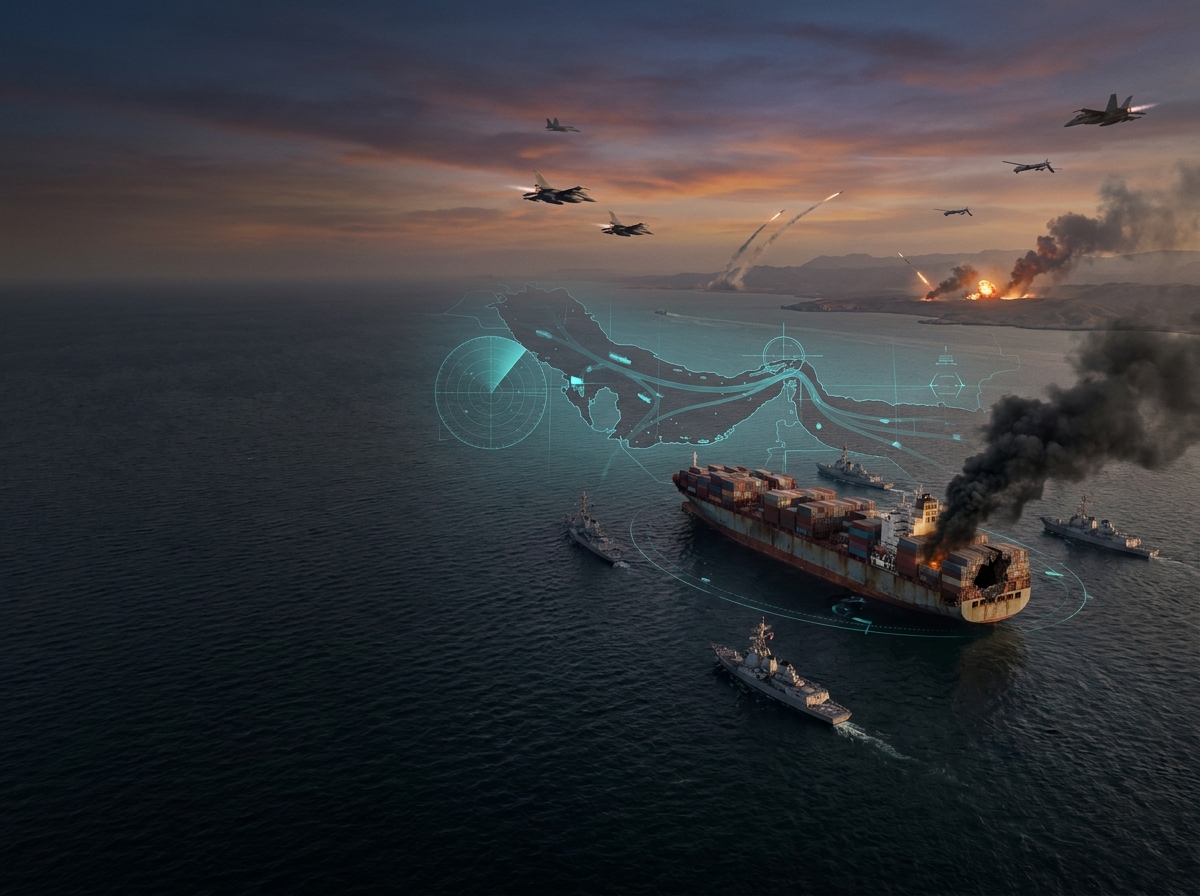
The geopolitical stability of global energy markets faced an immediate crisis on July 11–12, 2026. Following an attack by the Islamic Revolutionary Guard Corps (IRGC) on the Cyprus-flagged container vessel M/V GFS Galaxy, U.S. President Donald Trump officially declared the mid-June ceasefire over. U.S. Central Command (CENTCOM) quickly responded with massive precision airstrikes, hitting over 140 Iranian military targets in a single night. Iran countered with widespread missile and drone salvos against U.S. installations across the Gulf, striking targets in Qatar, Kuwait, Jordan, and Oman. This sudden escalation highlights the fragile nature of international chokepoints and the growing risk of regional conflict.
Table of Contents
- The Collapse of the Islamabad Memorandum of Understanding
- The Attack on the M/V GFS Galaxy and the Indian Crew Crisis
- The Article 5 Dispute: Legal Friction Over Transit Fees
- Regional Escalation: Gulf Cooperation Council States in the Crossfire
- Global Supply Chain Consequences and Rerouting Metrics
- Strategic Takeaways for Global Leaders
The Collapse of the Islamabad Memorandum of Understanding
The current conflict follows months of instability. The 2026 Iran War began on February 28 with Operation Epic Fury, a joint U.S.-Israeli air campaign that struck Iranian nuclear facilities and resulted in the assassination of Supreme Leader Ayatollah Ali Khamenei. After weeks of intense fighting, international mediators in Oman helped broker a temporary truce, which led to the signing of the Islamabad Memorandum of Understanding (MoU) on June 17, 2026.
[June 17: Islamabad MoU Signed] ──> [July 7: Transit Fee Friction] ──> [July 12: Ceasefire Declared Over]
The accord was designed to establish a 60-day window to gradually reopen the Strait of Hormuz to commercial shipping. However, the agreement fell apart due to disagreements over maritime authority. The new Iranian regime, led by Mojtaba Khamenei, attempted to establish strict control over the waterway, leading President Trump to declare the ceasefire dead and resume military operations.
The Attack on the M/V GFS Galaxy and the Indian Crew Crisis
The tipping point occurred when the IRGC targeted the M/V GFS Galaxy, a Cyprus-flagged container ship transiting the southern lanes of the strait. The strike caused severe damage to the ship’s engine room and ignited a major fire, leaving the vessel disabled.
The attack created an immediate diplomatic issue for India, as the ship’s crew included 11 Indian nationals. A joint rescue operation by Omani emergency teams and the Indian Embassy successfully saved 10 crew members, while 1 remains missing. India’s Ministry of External Affairs quickly issued a strong statement condemning the attack and calling for an immediate de-escalation to protect civilian mariners and restore safe navigation.
The Article 5 Dispute: Legal Friction Over Transit Fees
The core of the conflict lies in differing interpretations of Article 5 within the Islamabad MoU:
| Country | Interpretation of Article 5 | Shipping Lane Preference |
| Islamic Republic of Iran | Believes it has the right to charge transit fees and dictate routing after a 60-day window. | Demands ships hug the northern Iranian coast for verification. |
| United States & Allies | Views the strait as an international waterway that must remain free and open. | Utilizes alternative southern routes along the Omani coast. |
This legal disagreement has had direct operational consequences. When commercial vessels followed the U.S.-designated southern routes, the IRGC labeled them “unapproved paths,” using this as justification to fire warning shots and deploy anti-ship missiles.
Regional Escalation: Gulf Cooperation Council States in the Crossfire
Iran’s response to the CENTCOM airstrikes significantly expanded the geographic scope of the conflict. Moving beyond standard naval skirmishes, the IRGC launched coordinated ballistic missile and drone attacks against U.S. military assets located within allied Gulf states.
[CENTCOM Attacks Coast Targets] ──> [IRGC Fires Ballistic Missiles] ──> [Strikes Hit Al Udeid Base, Qatar]
A major strike targeted the Al Udeid Air Base in Qatar, a key operational hub for U.S. forces in the region. The attack damaged jet maintenance facilities and forced regional air defense networks in the UAE and Bahrain into active intercept modes. Falling shrapnel also caused civilian injuries in Doha, demonstrating that neighboring neutral states are increasingly vulnerable to the spreading conflict.
Global Supply Chain Consequences and Rerouting Metrics
The instability in the Strait of Hormuz has forced global logistics firms to quickly alter their operations. Because the chokepoint handles 20% of global oil and LNG flows, major container shipping lines have begun rerouting vessels around the Cape of Good Hope to avoid the area.
This detour adds 14 to 20 days to standard transit timelines between Asia and Europe, leading to a sharp increase in operational costs and marine insurance premiums. If the closure persists, the global economy could face renewed inflationary pressures reminiscent of previous energy crises.
Strategic Takeaways for Global Leaders
- The Failure of Static Truces: Diplomatic agreements that leave room for ambiguous interpretations of sovereignty are highly vulnerable to sabotage by hardline factions.
- Asymmetric Maritime Threats: The use of land-based anti-ship cruise missiles and low-cost drones allows coastal nations to challenge traditional naval forces in narrow waterways.
- The Need for Resilient Supply Chains: Modern enterprises must move away from single-point transit routes, building flexible logistics networks that can adapt to sudden geopolitical disruptions.
Conclusion
The collapse of the Islamabad truce and the expansion of strikes across the Gulf mark a dangerous new phase in the U.S.-Iran conflict. With President Trump taking a firm stance on maritime transit rights and Iran striking targets across the region, the risk of a broader conflict remains high. Re-establishing long-term stability will require clear, enforceable agreements that secure international waterways and protect global trade from unilateral control.
How should international trade groups adjust to the growing security risks in the Strait of Hormuz? Will the deployment of naval escorts be enough to safeguard shipping lanes? Share your thoughts in the comments section below!