

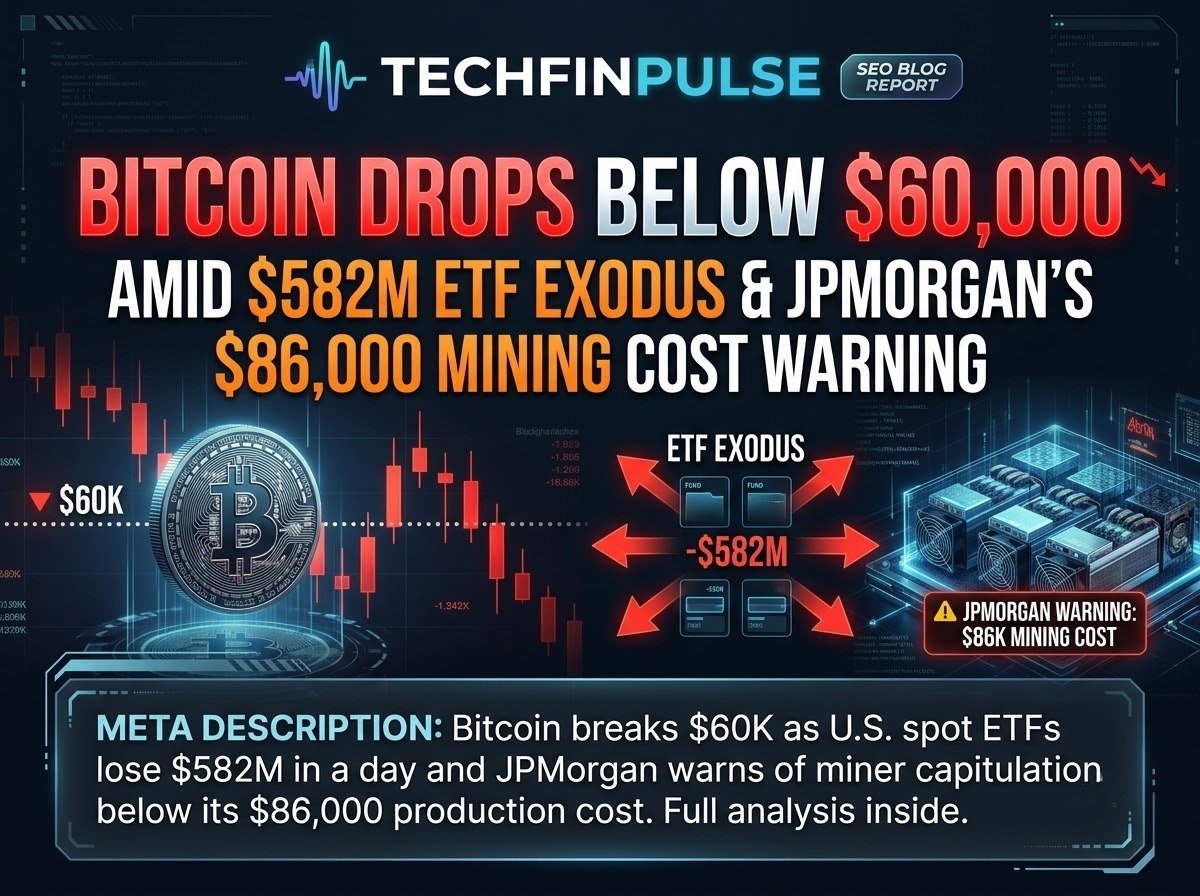
Bitcoin breaks $60K as U.S. spot ETFs lose $582M in a day and JPMorgan warns of miner capitulation below its $86,000 production cost. Full analysis inside.
Table of Contents
- Introduction: The Double Shock Hitting Crypto Markets
- Anatomy of the $582 Million Spot Bitcoin ETF Exodus
- Retail Rotation vs. Institutional Accumulation
- JPMorgan’s $86,000 Production Cost Warning Explained
- The Hidden Catalyst: Miners Selling Bitcoin to Fund AI Data Centers
- How Mining Difficulty Adjustments Reset the Market
- Key Takeaways for Investors
- Conclusion
Introduction: The Double Shock Hitting Crypto Markets
On November 20, 2026, Bitcoin breached one of its most closely watched psychological thresholds, sliding below $60,000 to trade in the $58,314 to $59,059 range. This sharp downturn extended a month-long correction that has erased roughly 25% of Bitcoin’s market value, dragging Ethereum down toward $1,612 and Solana near $69.
While sudden price drops often trigger speculation on social media, institutional data reveals two concrete, structural forces driving the sell-off: an accelerating wave of redemptions from U.S. spot Bitcoin exchange-traded funds (ETFs) and intense financial pressure on cryptocurrency miners operating deep below their average production costs.
Anatomy of the $582 Million Spot Bitcoin ETF Exodus
According to market data from Farside Investors and SoSoValue, U.S. spot Bitcoin ETFs recorded $582.3 million in single-day net outflows on Thursday, November 19. This marked the third consecutive trading session of heavy withdrawals—following $239.9 million in outflows on November 17 and $306.5 million on November 18—pushing cumulative November redemptions to approximately $3.47 billion.
The breakdown of Thursday’s outflows highlights a concentrated exit from the market’s largest funds:
- BlackRock’s iShares Bitcoin Trust (IBIT): Accounted for $541.1 million—roughly 93% of the day’s net outflows—marking its largest single-day withdrawal since launching in January 2024.
- Fidelity’s Wise Origin Bitcoin Fund (FBTC): Recorded $46 million in net redemptions.
- ARK 21Shares Bitcoin ETF (ARKB): Saw $31 million leave the fund.
- Grayscale Bitcoin Trust (GBTC): Experienced $14 million in outflows.
With spot exchange trading volumes already down 40% from September to October, thin order books amplified the price impact of these redemptions, triggering over $1 billion in leveraged long liquidations across derivatives markets within 24 hours.
Retail Rotation vs. Institutional Accumulation
A surface-level reading of the ETF data might suggest that Wall Street institutions are abandoning Bitcoin altogether. However, market intelligence points to a much more nuanced reality.
In a research note led by strategist Nikolaos Panigirtzoglou, JPMorgan analysts observed that while spot crypto ETFs suffered substantial outflows across October and November, institutional positioning in CME crypto futures remained relatively stable. JPMorgan attributed the bulk of the ETF selling to retail investors rotating capital out of crypto ETFs and back into traditional stock ETFs. Shifting expectations around Federal Reserve interest rate cuts, combined with weakness in technology stocks and rising borrowing costs, have pushed risk-averse retail participants toward equities.
Furthermore, not every asset manager was selling on November 19. Morgan Stanley’s Bitcoin Trust (MSBT) defied the broader market panic, attracting $49.6 million in net inflows on the exact same day BlackRock saw record exits.
JPMorgan’s $86,000 Production Cost Warning Explained
Compounding the demand-side ETF outflows is a growing supply-side threat from Bitcoin miners. In its November 18 analysis, JPMorgan estimated that the average cost to mine a single Bitcoin had risen to $86,000—climbing above its earlier 2026 range of $77,000 to $85,000.
When JPMorgan published that note, Bitcoin was trading near $65,000, leaving miners with an average shortfall of $21,000 per coin. By November 20, Bitcoin’s slide below $60,000 stretched that profitability deficit past $26,000. Because electricity contracts, facility leases, and hardware amortization do not pause when market prices drop, higher-cost mining operators have been forced to liquidate Bitcoin from their corporate treasury reserves just to sustain daily operations.
The Hidden Catalyst: Miners Selling Bitcoin to Fund AI Data Centers
Perhaps the most significant insight in JPMorgan’s November 20 market update involves where that liquidated miner capital is going. Analysts noted that unprofitable miners are not merely selling Bitcoin reserves to pay utility bills—many are actively selling coins to finance strategic pivots into artificial intelligence infrastructure.
Bitcoin mining facilities possess two scarce assets highly coveted by AI hyperscalers: massive high-voltage power interconnects and industrial cooling capacity. When Bitcoin mining margins turn deeply negative, repurposing energy infrastructure to host AI compute becomes an attractive survival mechanism, creating an unexpected bridge between crypto market supply and AI capital expenditure.
How Mining Difficulty Adjustments Reset the Market
Historically, Bitcoin’s average production cost has functioned as a “soft floor” for price. While Bitcoin can trade below production cost during acute macro corrections, the network contains an automated self-balancing mechanism.
As high-cost miners capitulate and shut down unprofitable rigs, the total computing power securing the blockchain (network hashrate) declines. In response, Bitcoin’s protocol automatically lowers its mining difficulty. A lower difficulty makes it computationally easier—and therefore cheaper—for the remaining efficient miners to earn block rewards, gradually narrowing the gap between market price and production cost and alleviating forced reserve selling.
Key Takeaways
- Historic ETF Outflows: U.S. spot Bitcoin ETFs lost $582.3M on November 19, bringing cumulative monthly outflows to ~$3.47B, led by BlackRock’s IBIT (-$541.1M).
- Contrarian Inflows: Morgan Stanley’s MSBT bucked the trend with $49.6M in net inflows, while institutional CME futures positioning remained steady.
- Severe Miner Squeeze: With JPMorgan estimating average mining costs at $86,000, Bitcoin’s drop below $60,000 has created a >$26,000 per-coin deficit.
- The AI Infrastructure Shift: Struggling miners are liquidating BTC reserves both to cover operating costs and to fund pivots into AI data centers.
- Built-In Stabilization: Hashrate declines and upcoming mining difficulty adjustments are expected to lower production costs for surviving operators over time.
Conclusion
Bitcoin’s drop below $60,000 is the result of a rare convergence between retail ETF redemptions, tighter macro liquidity, and miner balance-sheet restructuring. While short-term volatility remains elevated until ETF outflows stabilize and mining difficulty adjusts downward, the underlying network mechanics are actively working to flush out excessive leverage and inefficient operators.
What is your take on miners selling Bitcoin reserves to fund AI data centers—is this a temporary supply overhang or a permanent shift in mining economics? Share your thoughts in the comments below.